
GraphRAG Gets You Retrieval. Knowledge Graphs Give You Reasoning. But Can You Prove It?

Enterprises are no longer asking whether to adopt GraphRAG. They are asking why it is not doing what they expected. The answer is almost always the same. They built retrieval, but they needed reasoning.
Three misconceptions are shaping how enterprises approach GraphRAG. Each one is understandable. Each one is expensive. And each one compounds the others.
Before we get into them, one distinction matters for everything that follows:
Reasoning: The ability to follow connected paths across a structured knowledge graph, trace the reasoning behind a conclusion, and produce outputs that can be audited and defended.
Memory: The ability to persist decision context across sessions, making the why behind decisions queryable over time. That is a different architectural layer and a different post.
Misconception one: Fixing hallucinations is all GraphRAG can do
The dominant pitch for GraphRAG right now is straightforward: your RAG system hallucinates because it retrieves via similarity rather than verified relationships. GraphRAG fixes that. More accurate retrieval. Fewer hallucinations. Answers you can trust.
That pitch is accurate. Hallucination reduction is a real, measurable benefit of GraphRAG and a legitimate reason to adopt it. The vendors have recognized this and built hybrid systems that natively combine vector and graph retrieval. That is the right architecture. Enterprises asking whether GraphRAG reduces hallucinations are asking the right question.
The problem is not the question. The problem is that it is the only question being asked.
Because GraphRAG is not an upgrade to RAG. It is a fundamentally different architectural commitment. RAG retrieves text chunks by semantic similarity. GraphRAG extends that with graph traversal, using similarity to find the initial entry points in the graph and then following relationship paths to surface connected knowledge.
Hallucination reduction is the entry requirement. It is not the finish line. Once you clear that bar, a different set of questions determines whether you built something that can actually reason, or just something that retrieves more reliably.
Those questions are not being asked often enough:
When the agent makes a decision, can you trace why it made that decision?
Is the knowledge graph underlying this system designed to support reasoning, or was it built to serve the retrieval layer already in place?
When a regulator or a CFO asks why the system produced a particular output, does the architecture give you an answer?
The difference matters in practice. A retrieval system finds the contract clause that mentions force majeure. A reasoning system goes further: it traverses the graph to determine whether that clause applies to this specific supplier under this contract version, given their compliance history, the regulatory framework currently in effect, and any prior exceptions granted. Retrieval finds the text. Reasoning finds the answer.
Every one of those questions is an architecture question. They ask whether the system was designed to reason or just to retrieve, and whether its decisions can be traced, audited, and trusted.
An enterprise that only asks about hallucination reduction will build a system that retrieves reliably and stops there. It will hit a ceiling the moment it asks the system to do anything that requires auditability across decisions or accountability across time.
GraphRAG makes all of that possible. But only if you go in asking the right questions from the start.
Misconception two: the graph in GraphRAG is an afterthought
Here is what GraphRAG implementations look like when they start from the wrong question. A team decides to adopt GraphRAG. They build or buy the retrieval layer. They set up the agent orchestration. They connect it to an LLM. Then, somewhere near the end of the project, they ask: what is the graph actually built on?
The graph comes last. It is treated as an index, a lookup structure, a way to organize the chunks that the vector search has already found. It is not designed. It is derived.
That is exactly backward.
Automated graph extraction is now a standard feature of GraphRAG tooling. Point a pipeline at your documents, and it produces a graph. In practice, many teams never design the graph at all. The pipeline extracts it for them: entities pulled from documents, relationships inferred from content, and a graph produced automatically. That capability is real, and it has made GraphRAG accessible to teams that would never have had the bandwidth to build a knowledge graph from scratch.
But automated graph extraction is not the same as graph design. And that distinction is where most enterprise GraphRAG implementations run into trouble.
The limit is not what automated extraction produces. It is what it cannot produce. It captures what your documents say. It does not enforce what should be true. It does not maintain provenance, chain of custody, or controlled vocabulary. It does not tell a regulator who is accountable for the knowledge structure or how it is maintained. For retrieval, that may be acceptable. For reasoning, governance, and consequential decisions, it is not enough.
An auto-extracted graph is a mirror of your content. It reflects what your documents say. A designed knowledge graph is a model of your domain. It reflects what your enterprise knows, how your domain is structured, what your governance requirements are, what your compliance obligations demand, and how your entities actually relate to each other in the real world.
GraphRAG reasoning on a content mirror will find what is in the documents. GraphRAG reasoning on a domain model will find what is true about your business.
For a life sciences company tracing adverse event relationships across clinical trial data, a cybersecurity team mapping threat actor relationships across an active incident, or an energy company tracking compliance obligations across a contractor network, that difference is not academic. It determines whether the system can be trusted for consequential decisions.
The knowledge graph is not a byproduct of GraphRAG. It is the foundation GraphRAG reasons on top of. If the graph does not have governed entities, verified relationships, schema, lineage, and provenance built in from the start, then GraphRAG is traversing a reflection of your content rather than a model of your domain.
The tooling automates graph extraction. It does not automate graph design. Those are different problems, and so far only one of them has been solved.
Misconception three: GraphRAG is being evaluated in isolation
The dominant evaluation pattern in the market right now is some version of this: does GraphRAG outperform vanilla RAG? On retrieval accuracy, answer quality, latency, and cost. GraphRAG versus the baseline.
That comparison is necessary but not sufficient. Knowing that GraphRAG outperforms vanilla RAG on retrieval tells you something important. Fewer hallucinations. But it does not tell you whether you are building toward a system that can reason.
Those are different questions that lead to different architectural choices. A system optimized to beat vanilla RAG on retrieval benchmarks will be tuned for accuracy on the retrieval step. A system built to reason will be designed for multi-hop traversal, auditable decision paths, and data-level governance. The first system might win the benchmark. The second system is what enterprises actually need.
Here is what makes this evaluation pattern particularly costly: when GraphRAG is benchmarked against vanilla RAG, the knowledge graph layer is invisible in the comparison. It does not show up in the score. What gets measured is the output of the retrieval step. What is not measured is whether the underlying graph was designed well enough to support reasoning at scale, whether the decision path is auditable, or whether the system will hold up under production load.
When the knowledge graph is invisible in the evaluation, it becomes invisible in the design. Teams optimize for what they measure. If the benchmark does not ask about auditability or depth of reasoning, the architecture will not be built for them either.
The questions that matter most do not come from the GraphRAG-versus-RAG benchmark. They come from asking what you are actually trying to build.
Is the system being evaluated on whether the decision path is auditable, or only on whether it retrieved the right answer this time?
Is the knowledge graph being evaluated as a designed domain model, or only as a retrieval index that happened to perform well?
Those are the questions the market is not asking at scale. Not because practitioners are incapable of asking them. But because the dominant evaluation pattern does not require them. And what the evaluation does not require, the architecture does not build.
What this means for how you build
GraphRAG is not the problem. The way the market is framing GraphRAG is the problem.
When you treat GraphRAG as a hallucination fix, you skip the architectural rethink it requires. When you treat the graph as an afterthought, you build retrieval on a foundation that was never designed to support reasoning. When you evaluate GraphRAG in isolation, you optimize for the wrong outcome and build toward a ceiling you will hit in production.
The enterprises that get GraphRAG right are not the ones with the best retrieval benchmarks. They are the ones who asked the right question from the start: are we building a system that can reason, not just retrieve?
Solving the three misconceptions gets you a system with a knowledge graph that reasons well, but not automatically one you can prove.
That question leads to a different architecture. The knowledge graph comes first, designed with governed entities, verified relationships, and built-in provenance. GraphRAG sits on top of that foundation, not the other way around. And the evaluation is not whether it beats vanilla RAG. It is whether it gets you closer to AI that can reason and be trusted.
But reasoning is not enough on its own. I have watched this distinction get blurred in market after market, and it matters enormously for enterprise AI in regulated industries.
Traceability: The ability to see which data the system retrieved and which paths it followed. GraphRAG gives you this. It is the entry requirement.
Explainability: The ability for a human to understand why the system reached a particular conclusion. Traceability is a necessary input, but it is not sufficient. Knowing which path the agent followed does not tell you why it weighted one relationship over another or why it produced this conclusion rather than another.
Auditability: The ability to prove to a regulator, an auditor, or a board what happened, when it happened, what policy was in effect, and who was accountable. Auditability requires a persistent, queryable record that survives beyond the session. It is not a feature of the output. It is a property of the architecture.
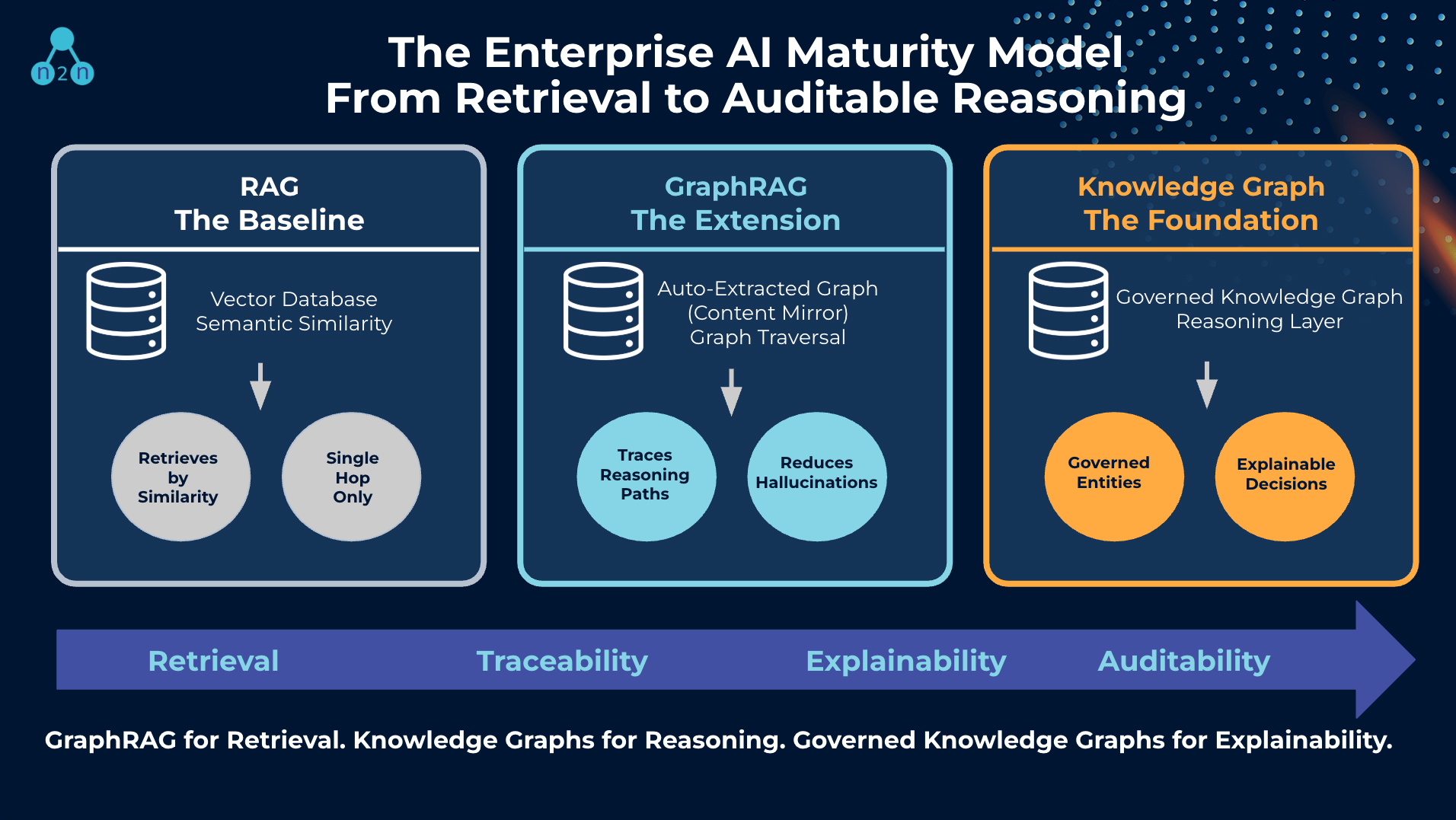
Fig 1: The progression in maturity from retrieval to auditable reasoning, and what each stage requires to get there.
Most GraphRAG implementations stop at traceability. Some achieve explainability. Almost none have auditability. And in regulated industries, an un-auditable decision is a non-compliant decision.
This is not a theoretical concern. The EU AI Act makes this concrete: high-risk AI systems must automatically log events throughout their lifecycle and retain documentation so regulators can assess compliance. Financial services regulators on both sides of the Atlantic are demanding clear proof of how AI-assisted decisions are made. Healthcare AI faces similar scrutiny under emerging FDA and EMA guidance, which emphasizes risk-based validation, governance, and robust documentation to ensure AI-supported decisions remain reviewable and defensible.
The knowledge graph is not just a retrieval layer. It is what makes the entire GraphAI stack trustworthy. Without a governed knowledge model at the foundation, you have explainability without auditability. And in regulated industries, that is not enough.
So, can you prove it? For most enterprises today, not yet. The architecture that bridges retrieval, reasoning, and auditability requires one more layer. Not a better retrieval system. Not a smarter agent. A persistent record of how decisions were made and why. That architecture has a name. And it is what the next post in this series is about.
Maya Natarajan is the founder of node2node and co-founder of State of the Graph. She advises enterprises on graph strategy and GraphAI architecture, and writes for technical leaders and the business stakeholders who want to understand the full potential of graph.
Sources
European Parliament and Council of the European Union. (2024). Regulation (EU) 2024/1689 laying down harmonised rules on artificial intelligence, Articles 12, 17, and 19. Official Journal of the European Union. Available at: https://eur-lex.europa.eu/legal-content/EN/TXT/?uri=CELEX:32024R1689
MmowW AI Compliance. (2026). Financial AI explainability requirements: Regulatory expectations across jurisdictions. Available at: https://mmoww.net/ai/industry/financial-ai-explainability/
European Medicines Agency and U.S. Food and Drug Administration. (2026, January 14). EMA and FDA set common principles for AI in medicine development. Joint news release. Available at ema.europa.eu and fda.gov.
https://www.ema.europa.eu/en/news/ema-fda-set-common-principles-ai-medicine-development-0