
The Graph Stack for the AI Era

AI did not simplify the graph technology market. It exploded it. What was once a niche infrastructure conversation is now three simultaneous urgent conversations happening in parallel. Almost nobody has a framework that holds all three together. This is that framework.
The three conversations are real and happening in every serious enterprise graph project right now. The infrastructure team is discussing graph databases: performance, scalability, query latency, and live data. The knowledge management team is talking about meaning and governance: what entities are, how they relate, what can be trusted about them, and who is accountable for that knowledge. The AI team is talking about retrieval, agents, and reasoning: GraphRAG, memory, LLMs. All three are talking about graph. All three are correct. And in most enterprises, none of them is talking to each other.
That is not a people problem. It is an architecture problem. And it has a solution.
Three layers. Most enterprises are building one.
The graph technology space has split into three structurally distinct layers:
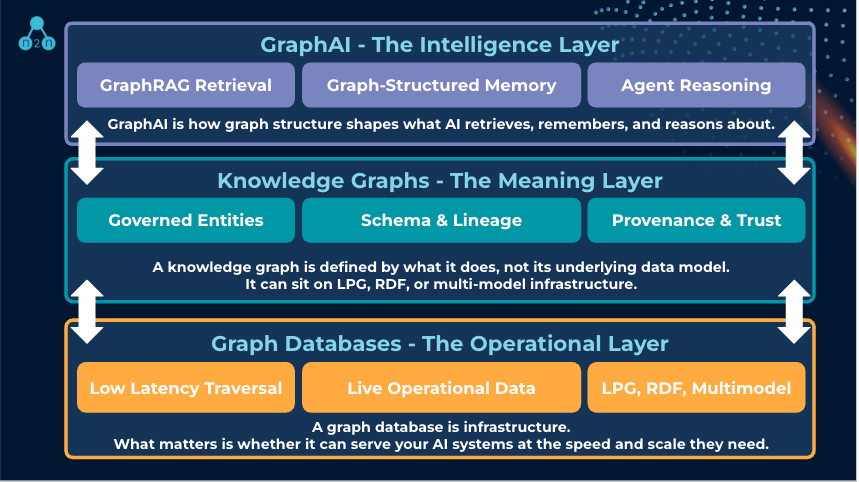
Graph Databases: the operational infrastructure. Where graph data lives, where traversals execute, where AI systems stay close to live operational state.
Knowledge Graphs: the meaning layer. Where entities, relationships, policies, and governance live as a machine-readable, governed structure that AI systems can trust.
GraphAI: the intelligence layer. Where graph structure actively shapes how AI systems retrieve context, maintain memory, and reason across connected data.
AI has made all three necessary at once. That is what changed. Before 2023, an enterprise could invest in one layer and defer the others. That option is gone. An AI system without operational graph infrastructure cannot act on live data. Without a knowledge graph, it cannot act on governed meaning. Without GraphAI architecture, it cannot remember, reason, or be trusted.
Most enterprises are building one layer, usually the database, and wondering why the AI is not working.
The database layer: more complex than it looks
Graph databases are where graph theory becomes operational infrastructure. Nodes and relationships as first-class citizens. Low-latency traversal. Live data, not stale snapshots.
What AI has done to this market is force a diversification that the pre-AI era never required. Based on the State of the Graph Graph Database Catalog, a comprehensive vendor-neutral analysis of the market I co-founded, the landscape now breaks into four patterns: 40% pure LPG systems built for real-time AI and agents, 38% multi-model systems where graph meets the broader data stack, 20% pure RDF systems, and 2% dual platforms supporting both models natively.
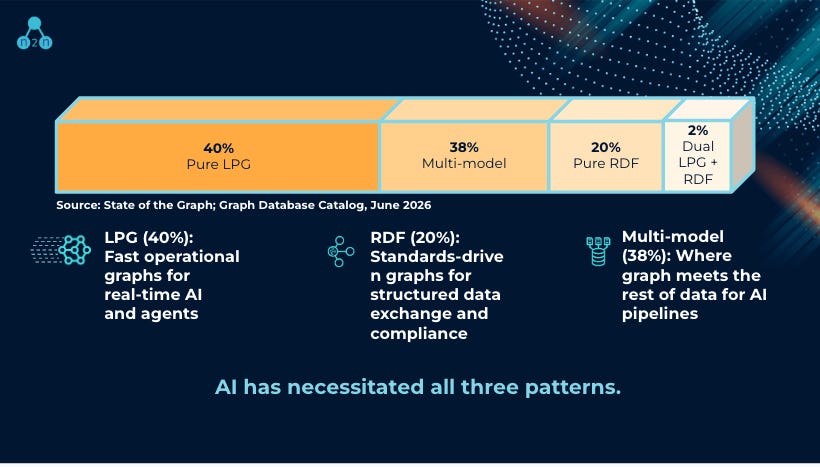
The graph database market has never offered enterprises more architectural choice than it does right now. The challenge is knowing which choice fits which problem.
Three things make the database layer specifically matter for AI:
Multi-hop traversal at low latency. This is the capability that most AI architects underestimate until they hit the ceiling. Vector search finds similar items. Graph traversal finds connected components. These are fundamentally different operations. An AI system that can only retrieve by similarity will miss exactly the relationships that make graph data valuable in the first place.
Hybrid operational and analytical workloads. GraphAI needs both simultaneously: write-heavy operational queries that act on live state, and read-heavy analytical traversals that find patterns across the whole graph. Historically, these lived in separate systems with pipelines between them. For agents that need to act and reason simultaneously, that lag is unacceptable.
Proximity to live data. Agents that need to act on the current state cannot reason reliably over yesterday’s data. This sounds obvious. It is consistently underdesigned.
The knowledge graph layer: where most stacks break
If there is one insight I want to leave you with from this post, it is this: a knowledge graph is not a more sophisticated graph database. It is a different thing entirely.
A knowledge graph is a machine-readable domain model, governed, structured, and queryable, that gives AI systems meaning they can act on and humans can audit. Schema, lineage, provenance, and governance as first-class architectural citizens. Not features. Not add-ons. Foundational commitments.
Critically, a knowledge graph is defined by what it does, not by its underlying data model. That is an implementation decision that follows from requirements. What matters is whether governed meaning exists in your architecture, regardless of the data model it sits on.
The simplest way I know to state the distinction between layers: a graph database stores data. A knowledge graph gives that data meaning that traverses systems, teams, and regulatory boundaries.
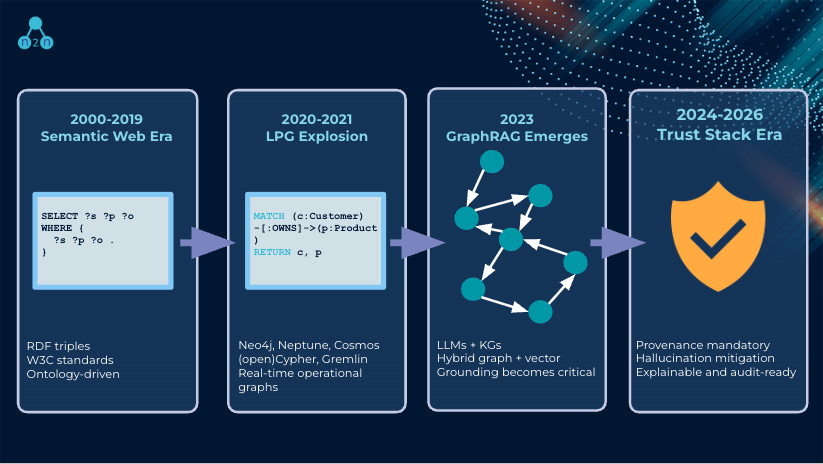
GenAI transformed the role of knowledge graphs faster than almost any other development in the stack. Four eras tell that story:
2000-2019: The Semantic Web Era. The intellectual foundations were built. Powerful in theory. The community built what the AI era is now building on, but mainstream enterprise adoption never arrived.
2020-2021: The LPG Explosion. Real-time operational graphs went mainstream. The operational use cases were so immediate and compelling that the meaning layer got deferred. Enterprises built graph databases. Most never built the meaning layer on top. That gap is still open.
2023: GraphRAG Emerges. LLMs met knowledge graphs. Hybrid graph and vector retrieval became the dominant pattern for grounding language models in structured knowledge. Hallucinations made the cost of skipping the meaning layer visible in a way no analyst report ever had. Suddenly, the knowledge graph was not a governance nice-to-have. It became a trust mechanism.
2024-2026: The Trust Stack Era. Provenance is now mandatory. Hallucination mitigation is a design requirement. Explainability is an enterprise non-negotiable. The knowledge graph is the layer that makes AI defensible, not just functional.
Three roles define what a knowledge graph does for AI:
Context backbone. The structured, governed meaning that AI systems need to reason correctly, not just retrieve plausibly.
Defensible AI. Vector retrieval finds similar text. Knowledge graph retrieval finds verified relationships. The difference between those two is the difference between an answer that sounds right and one that is right, and one you can defend.
Trust differentiator. The knowledge graph maintains policies and provenance as governed, queryable assets. This is the foundation that makes AI auditable at the data level. How decisions are made and why they were made is a separate architectural layer, one we will return to later in this series.
The GraphAI layer: where it all comes together, or does not
GraphAI is the layer where graph structure meets AI systems directly. It is an active mechanism that shapes what gets retrieved, what gets remembered, and what gets reasoned about.
Two patterns define most of what matters here for enterprise:
GraphRAG. The knowledge graph provides structured retrieval context for language models. Instead of retrieving text chunks by semantic similarity, GraphRAG retrieves graph paths by relationship, enabling multi-hop reasoning that vector search cannot support on its own. The architecture combines vector retrieval for semantic similarity with graph traversal for relationship paths, feeding both into an LLM reasoning layer. The result is AI that can follow chains of connected knowledge across your enterprise, not just find similar sentences.
Graph-structured agent memory. Agents need to reason across sessions, not just within them. Token-based memory lets an agent recall. Graph memory enables an agent to reason by maintaining persistent, queryable state across entities, relationships, decisions, and policies that survive session boundaries. This distinction matters enormously in any domain where the history of decisions shapes the validity of the next one. Which, in enterprise settings, is almost every domain.
The underlying architecture that connects these patterns is more complex than most vendor diagrams suggest. Structured and unstructured data flows through chunking, entity recognition, embedding, and enrichment pipelines. The output feeds both a vector index and a knowledge graph. An agent orchestrator runs a plan-act-reflect cycle: decomposing goals, executing graph and vector queries, evaluating results, and iterating before synthesizing a response. Anyone selling a simple version of this architecture should be asked harder questions.
Consider a global manufacturer responding to a port closure. At the database layer, live relationships across every tier of the supplier network update in real time as the situation develops: which shipments are in transit, which routes are affected, which alternative suppliers are active. The knowledge graph takes that operational data and gives it governed meaning: which suppliers are certified, which contracts carry force majeure clauses, which alternatives have been validated, and what is known about their capacity and ESG commitments. The GraphAI layer sits on top of both. An agent retrieves live disruption data, reasons within the governed supplier context, and produces a recommendation for the procurement team to take to their CFO, with every step of the reasoning queryable, auditable, and traceable back to verified sources. That is what all three layers working together actually looks like.
The trust stack: the part nobody is building
Running across all three layers is what I am calling the trust stack. Four capabilities that make AI enterprise-ready, and that most implementations are not building deliberately.
Provenance and lineage. Every query, retrieval, and agent action is traceable back to its source. Built into the architecture from day one, not logged after the fact when the compliance question arrives.
Governance. Structure and policy are actively enforced, embedded in the meaning layer, and continuously validated.
Explainability. Decision paths that humans can inspect. Graph traces and audit trails that make agent behavior visible, not just to engineers, but to the business stakeholders and regulators who will eventually demand it.
Hallucination mitigation. Answers grounded in verified graph structure, not inferred from text similarity. Hybrid retrieval, citation enforcement, and compliance checks work in combination.
The trust stack is not a feature you add to a GraphAI system. It is an architectural commitment you make from the start. Or you do not make it at all.
What to do with this
Read this post again and ask three questions about your own architecture.
Which of the three layers do you actually have, not planned, not on the roadmap, but built and running?
If you have a knowledge graph, is governance genuinely baked into the architecture or bolted on top of a database?
Does your GraphAI system have a trust stack with built-in provenance, governance, explainability, and hallucination mitigation from the ground up?
Most enterprise GraphAI systems, evaluated against those three questions, have more gaps than their teams realize. The three-layer framework is not just a way to understand the market. It is a diagnostic for your own architecture.
Three layers. One stack. The enterprises that get this right will not just have better AI. They will have AI that reasons, remembers, and can be trusted. That is what GraphAI makes possible. And it starts with knowing which layers you have.
Maya Natarajan is the founder of node2node and co-founder of State of the Graph. She writes about graph strategy and GraphAI for technical leaders and the business stakeholders who want to understand the full potential of graph.